What are derivatives?
If you buy shares in a publicly traded company then the only money risked is the money used to purchase the shares (assumption: the money is your’s and not high interest credit card borrowing or the like.) Derivatives can, however, extend your losses beyond your initial investment. Therefore, they require not only detailed knowledge, but also control over the greed impulse. Even so called knowledgable investors have incurred large losses (sometimes insurmountable) when greed takes hold and the market moves against them. Many examples exist, including Nick Leeson a trader at no defunct Barings Bank, AIG Financial Products Division in the 2008 Financial Crisis, and Amaranth Advisors Hedge Fund in 2006, are a few examples.
For an investor, derivatives are complex financial contracts that can be used to manage portfolio risk, and generate income. However, since they are complex derivatives can quickly ruin a portfolio. Therefore, a more sophisticated understanding of derivatives is required than for stocks (equities).
So what is a derivative? Unfortunately, there does not exist one clear, concise definition that puts derivatives into a nice neat box. Definitions may be vague or just point to examples, such as, options, futures, swaps, and forwards.
For our purposes, we will start with “A derivative is a financial contract whose value is determined by the performance of the underlying asset.” The financial contract is the agreement between the buyer and seller for the purchase/sale of the asset, at a specified future date, at a predetermined price. The asset can be virtually anything that the parties determine has value.
Here is where we break the derivatives into two broad categories: Over-The-Counter (OTC) and Exchange Traded.
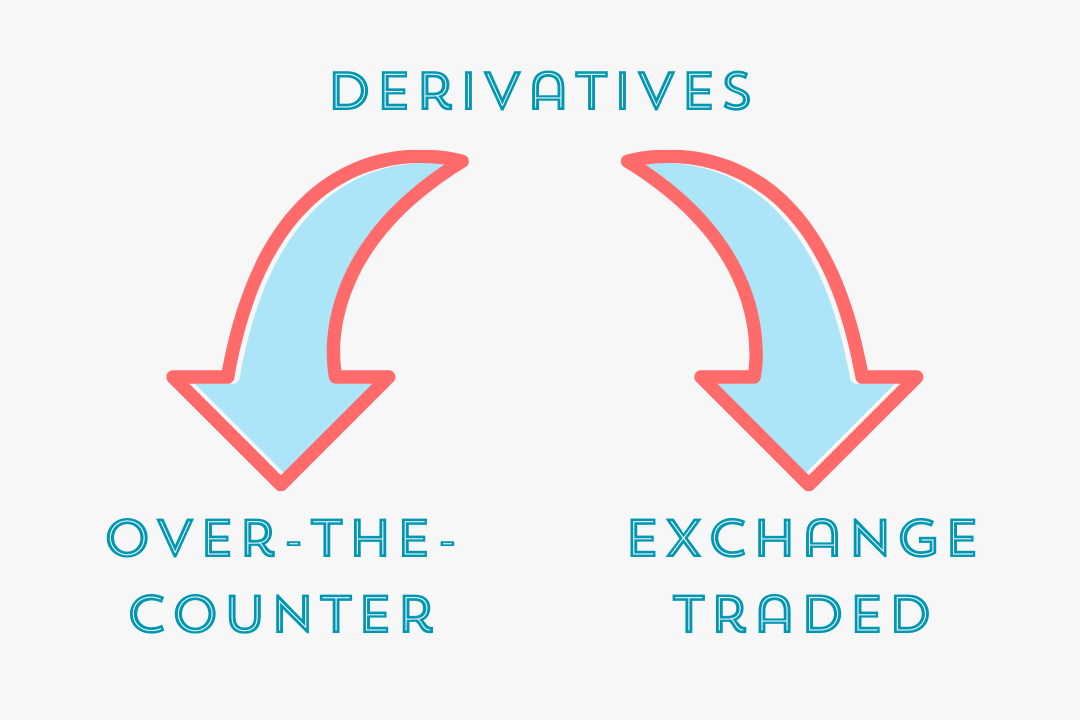
Exchange traded derivatives are traded on centralized regulated exchanges and can be entered and exited with the assurance a regulatory body is overseeing the transactions. They use standardized contracts, have high liquidity, and accessible by retail investors.
OTC derivatives are traded outside an exchange, directly between two parties and have customized contracts. They do require a sophisticated understanding of the underlying asset, such as credit default swaps. OTC derivatives are typically traded by governments, financial institutions, corporations, and sophisticated investors with adequate resources.
From hereon, we will concentrate on exchange traded derivatives, in particular options and to a lesser extent futures.
 Whatarederivatives.com